
Mining for gold 🍽
Drinks at Golden Hour and dinner at Oro show off the revamped Mining Exchange Hotel's craft and brand focus
The Mining Exchange Hotel got new ownership in 2022, and Practice Hospitality came to town. Slowly, changes have been made, particularly as it applies to the boutique property’s food and drink offerings.
That all started in October 2023 with whispers of an apothecary-inspired coffee shop.
In the spring of 2024 it launched, and I got my first taste of Blk Mgk. (Pistachio ube latte, anyone? It’s even better during 1-3 p.m. weekday happy hours when it’s $5.)
Then, come summer of 2024, Golden Hour lounge/bar opened across the main lobby, offering a half dozen small plates to accompany fine cocktails. (Go for live jazz, 5-8 p.m., Thursdays; or Americana, roots or country music performances, 4-7 p.m., Fridays.)
Trailing that by nearly a year, Oro, a Tuscan-inspired fine-dining restaurant kicked off in the former Springs Orleans spot.
That was in late April of this year, and I was heading out the door for a trip to Spain, so I missed covering the opening. But I picked back up in early June, when it was announced that Chef Noah Siebenaller had left Evergreen Restaurant to take the executive chef position for The Mining Exchange.
Still, I had yet to dine, so this writeup is to remedy that.
I’d been in touch with the property’s PR firm, and recently received press releases about a Dine & Unwind stay package that’s underway until year’s end (which includes a $100 dining credit on property) and updated Golden Hour lounge menus.
I’ve dropped into Blk Mgk several times on my own recently to remote work. (Another hot tip: Use Visit COS’ Crafts & Drafts passport at Blk Mgk and get a free Provision pastry with the purchase of a latte — screamin’ deal.) And I requested a tasting with Siebenaller at Oro, meanwhile visiting Golden Hour to buy us a couple of the fall cocktails.
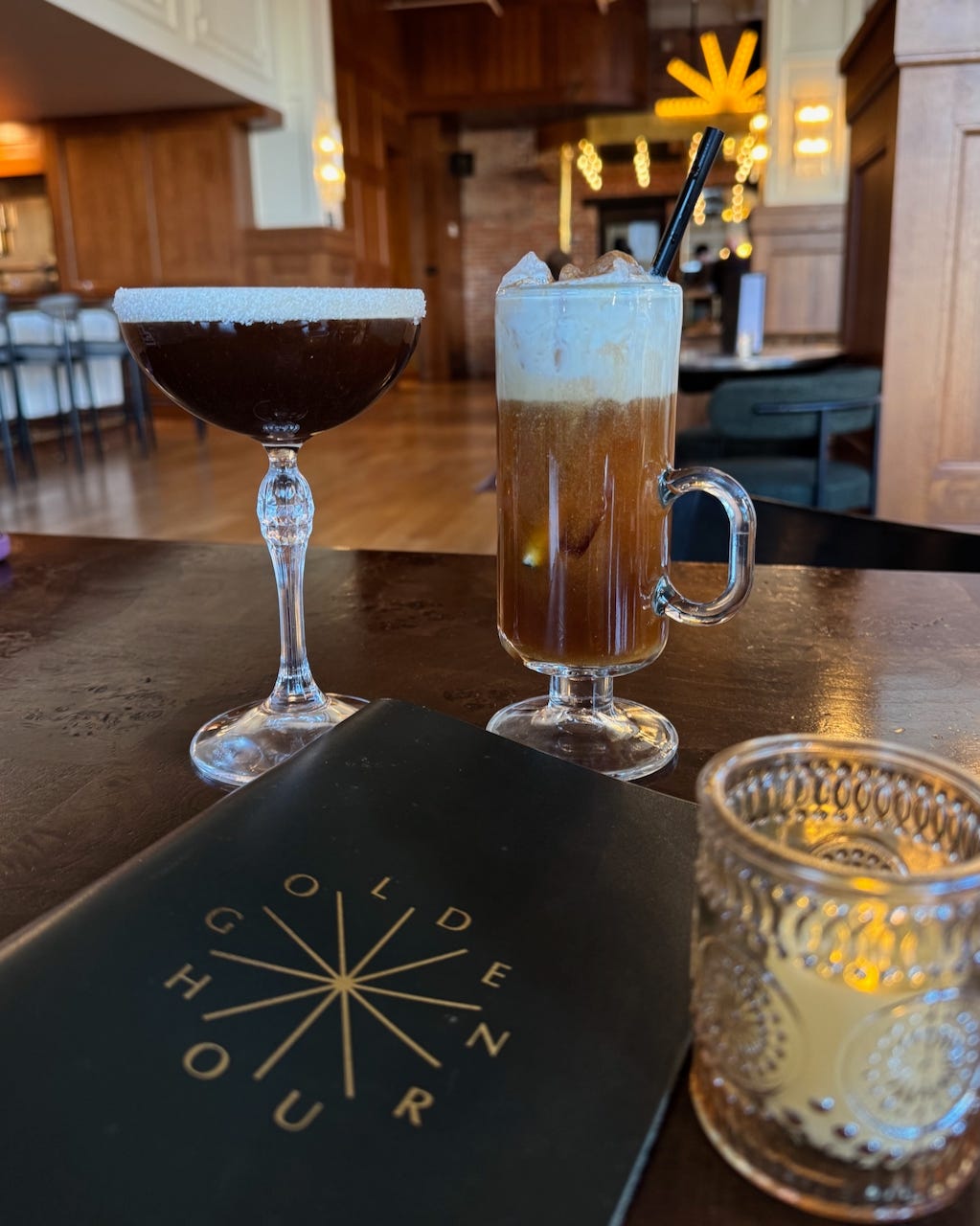
I probably talk too much in Side Dish about my fondness for Carajillos (most recently here and here), so it should be no surprise that I order the Pumpkin Carajillo cocktail at Golden Hour. Their rendition is less traditional and more complex, featuring a tri-spirit mezcal, tequila and Licor 43 blend plus cold brew (I sub in decaf espresso), pumpkin spice purée, cream and a cinnamon garnish. Like everything else you want to drink right now, it’s a taste of the holidays in a glass. The pumpkin spice doesn’t overwhelm, though, with more up-front agave spirits in the flavor to keep it sincere.
In a totally different direction, we also get a pomegranate cinnamon sour mocktail. It’s still fall in a glass, with a fruit tartness and lemony sourness balanced partly by a sugar rim. Aquafaba (chickpea brine as a vegan alternative to egg white) lends it some textural structure, and the spicing tastes tame enough to remain subtly evocative versus punching your palate.
Before departing, we run into longtime Brother Luck frontman Matt Sparks, who just recently became The Mining Exchange’s food and beverage director. We chat about in-room dining, banquet options across the multiple venues at the building, and the two lobby concessions more broadly. He says there’s corporate support for infusing as many local items into menus as possible, and I later hear that echoed by Siebenaller. In time, Sparks envisions an amaro program, plus adding more local spirits into cocktails, as well as attracting talented Springs bartenders to the spot.
He’s just come out of a staff meeting with Practice Hospitality’s VP of Brand & Communications, Kate Buska, and he shares a key thematic word from their discussion: alchemy. Part of that plays into the symbolism of aiming to make gold from disparate elements, which Sparks summarizes as “trying to thread all the things together around here, thinking about how one thing affects another.” Of course it also touches on the Mining Exchange’s own history as the hub of Cripple Creek’s gold wealth in the early 1900s: what the hotel’s founders themed the space around in 2012 when they developed it.


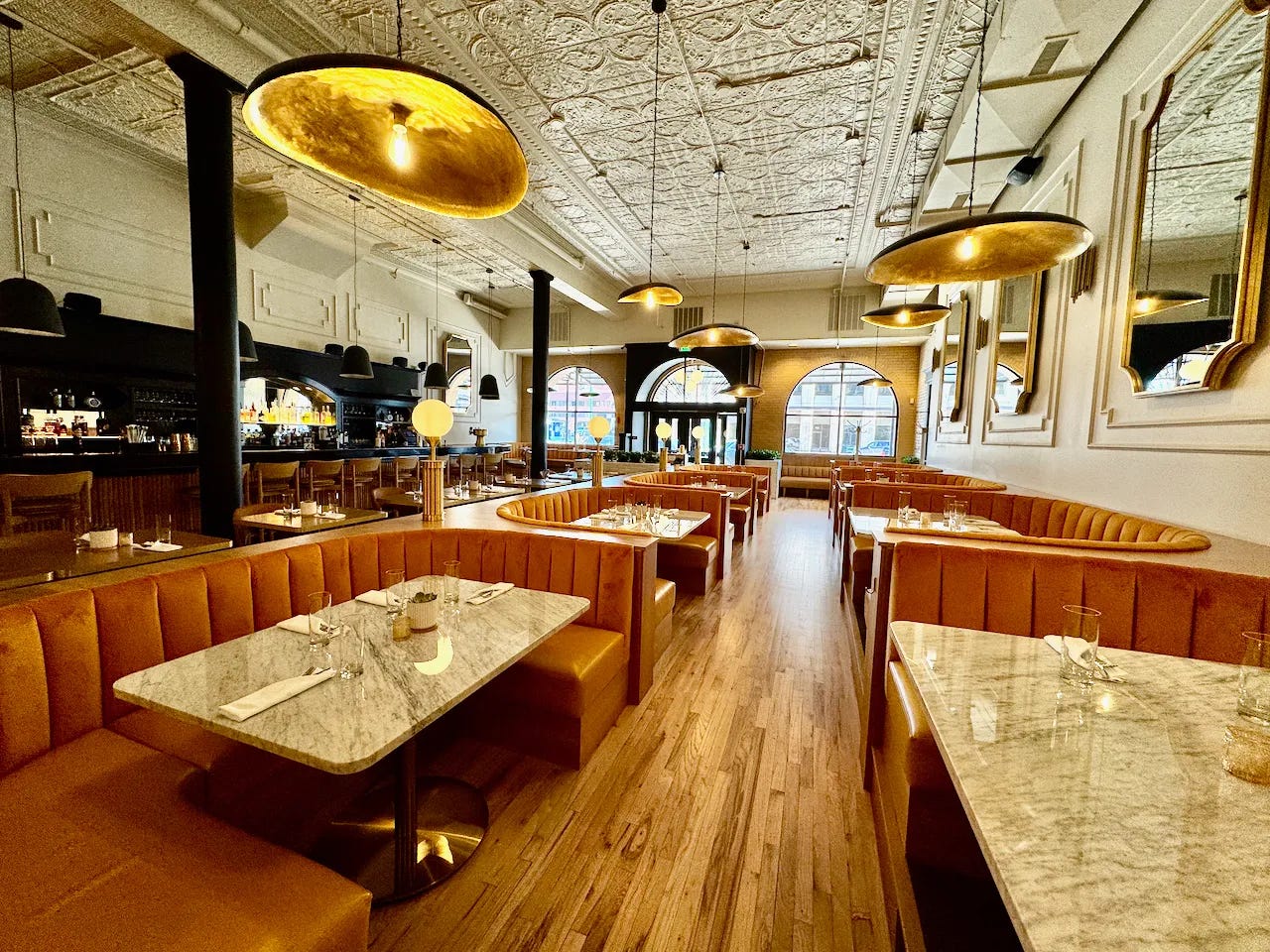
We bump into Buska on our way out and hear a little more from her, about inspiration for Oro derived from early Italian immigrants to the region. I can’t recall if she said it, or I just translated something else said, but I later find in my notes the phrase: “Tuscan sunset, but in Colorado.” Think of the name Golden Hour. Of warm lighting across the spaces, and striking Western art in Oro in particular, tying regional iconography into the layered story.
If all that sounds highfalutin, don’t worry. You can engage on a surface level and just enjoy the food and drinks. As a whole, The Mining Exchange doesn’t feel like a hotel restaurant/bar separated from the downtown community. Despite being designated a Wyndam Registry Collection Hotel (part of an elite portfolio) it feels right at home, mindfully designed to plug in and preserve a legacy.
One cool aspect about being a Collection property, says Siebenaller, is nothing is imposed on the property for standardization. (A recent example of brand standardization is at the Hilton Garden Inn which now hosts Ryze Skyline Lounge. Their F&B Director told me they were able to sidestep it because the second floor eatery there hosts the must-serve items that all Hilton Gardens carry for consistency.)
Siebenaller inherited most all of what’s currently being served from James Beard Award nominee Aaron Barnett, who consulted with Practice Hospitality to create Oro’s opening menu. That’s under the banner of Giant Squid Ink, a Portland-based company that Barnett runs with sommelier Joel Gunderson, who curated Oro’s savvy wine list.
The two have a great relationship according to Siebenaller, who says he’d just spoken to him that same morning. He says they’re moving more into a collaboration phase while Barnett maintains the consultancy, and that Barnett is open to input on what needs to change. They’ve now got months of customer feedback and sales data to inform decisions. Siebenaller also credits the work of Paul Ryan, his sous chef, and Jared Sorgenfrei, who runs banquets and oversees the lounge entities.
Siebenaller says he’s been working with recipes to create consistency and elevated dishes with minor touches. Though some items, like the rigatoni bolognese, are now totally his creation. “It’s the best version I’ve ever done,” he says, pointing to its authenticity and how its more of a meat sauce with a little tomato versus a tomato sauce with a little meat, as found in American-Italian cooking.
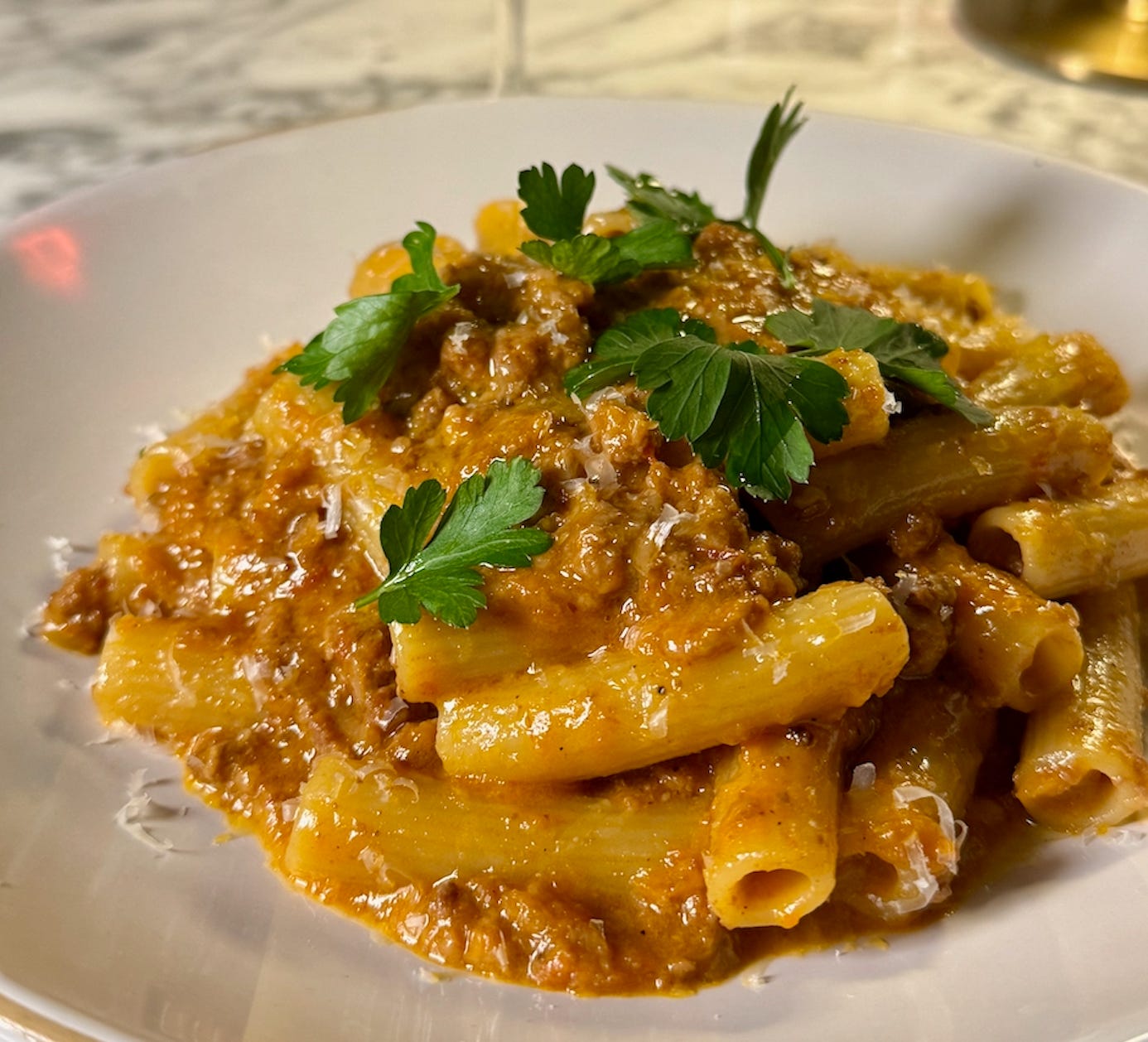
He sources local bison from Rock River Ranches for that dish, and ground beef and pork from Centennial Cuts. The pasta and pancetta components are imported from Italy. The dish starts in the pan as a minced (versus fine-chopped) mirepoix that’s sautéed and deglazed with red wine, then hit with veal stock. Next comes San Marzano tomatoes, tomato paste, butter and stages of Parmesan incorporation as it all reduces with the pork and beef.
The result is a potently hearty pasta dish where you’re left tasting the layers of each meat rather than a tart, acidic tomato sauce. It’s a beefy pork, or um, porky beef — a little unctuous and soft with its ground texture. There’s a pop of lemon citrus and I pick out some very faint nutmeg in the finish, evoking a béchamel sauce in a way. As much as it is the targeted elevated comfort food dish, it’s also just a total WWE SmackDown! for your mouth in the culinary sense.
Backing up to the beginning of our meal, the antithesis to the bolognese, while still forwardly meaty, is the delicate and light bison carpaccio. Calabrian chili oil gives it a spicy pop, and a thick sprinkling of 24-month aged Parmesan lends saltiness and creaminess supported by the cured egg yolk component. Shaved hazelnut, chives, arugula and microgreens add color contrast and sharp vegetal notes. It’s highly enjoyable to eat.


We nibble it alongside the ballsy Celery & Endive Alla Romana salad — and yes, I called a salad ballsy right there. ‘Cuz it is in this case. It offers a study in overlapping bitter and salty flavors, starting with the inherent endive and celery bitterness, but moving through salient bursts of caper saltiness and lightly fishy, garlic-anchovy vinaigrette. The anchovy component is actually Colatura di alici Italian fish sauce, and Puntarelle Alla Romana is a classic Roman salad. But since we don’t grow Puntarelle, an Italian chicory plant here, endive is the common substitution. (All this I just researched online; I don’t pretend to have known all that going in.)
Anyway, there’s also some mint, parsley, chile flakes and black pepper in the garnish and thin shavings of salty Pecorino Romano. Which brings me back to the overall pungency that’s at first surprising and attention-commanding, but quickly becomes not only tolerable, but fascinating and complex. A few bites in and I’m loving the item. The reason I call it ballsy is it’s easily intimidating to most American diners I would wager, being outright disgusting to those who won’t even eat a true Caesar Salad because the anchovies. (That’s a Mexican dish by creation, remember, as we digress.) Siebenaller says it’s probably the least-selling item on the menu, but he loves it too and would like to keep it around. He’s proud to not have to serve a common Caesar (to conclude said digression).
Just so you know that I’m not giving Oro a fluff job here and a total pass for providing the tasting — I wouldn’t do that to myself, them or my readers — I will tell you we were quite surprised and disappointed by the scallop crostini appetizer that arrived next. It’s a total miss; all conceptual with seemingly no care for how to eat the damn thing or the disparate textural elements that failed to find harmony.
I’ll explain: It’s built on quality rustic bread baked just a block away at Provision (how’s that for hyper local?). So, great toast, crunchy with grill marks and hard edges, just what you’d want for a crostini.
It starts to go awry with an absurd amount of garlic aioli (delicious on its own) spooned up into giant waves like in a Japanese painting. (Okay, now I’m being superlative, but you get the idea.) Then comes thin-cut lemon wheels with the rinds still attached, which will require you to pluck them from your mouth because they aren’t that pleasant to chew, despite the welcome pop of citrus they afford. Then the beautifully seared, double-stacked, soft scallops, again delightful on their own if they were presented as such. Add in some basil and microgreens and another touch of that Calabrian chili oil on-hand and again you can see the flavors in concept as working.
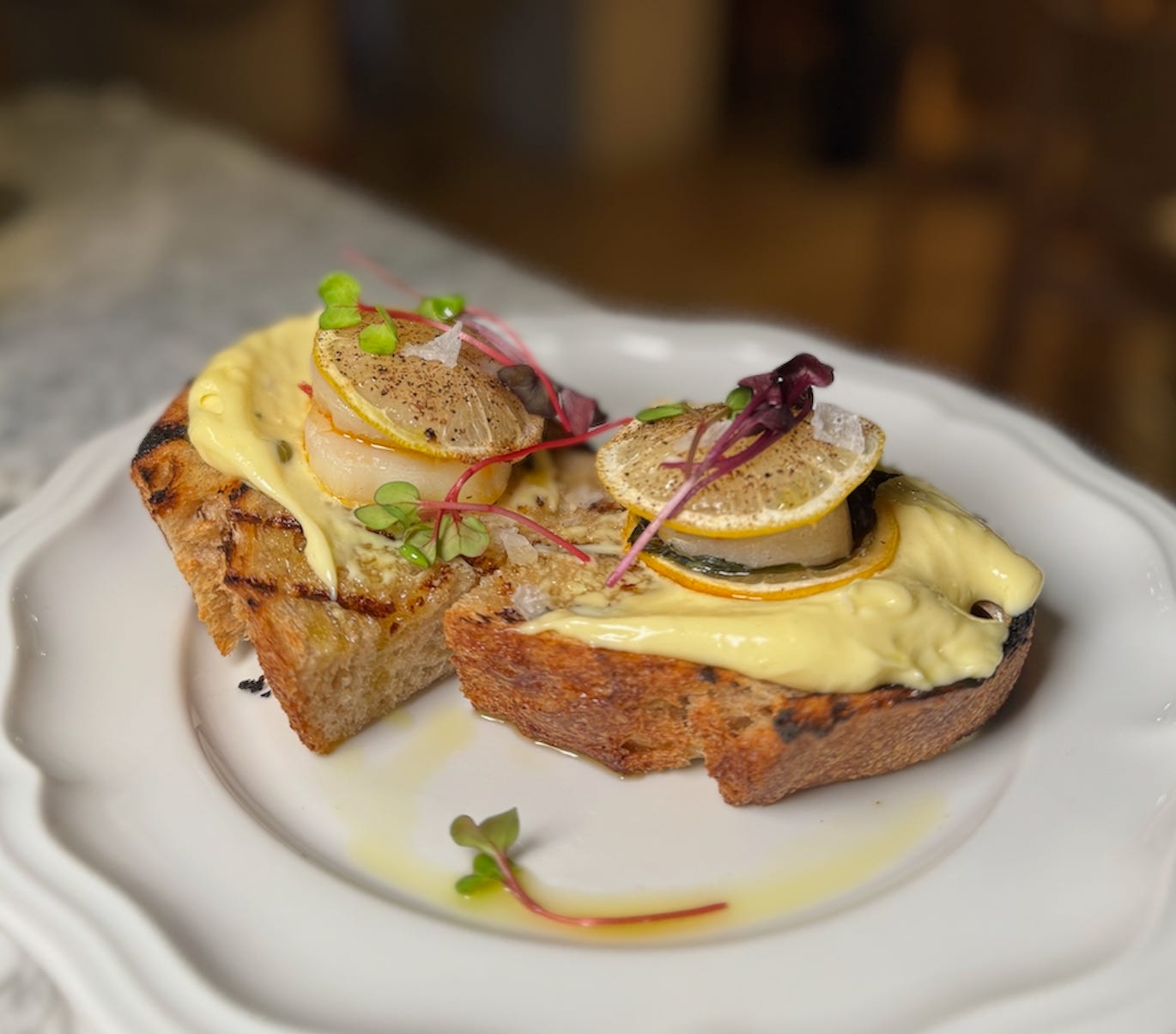
But back to the textures and eatability: You can try to take a bite and get aioli all over your face, or be delicate and knife-and-fork the construction, which will make it all fall apart as you try to get through the citrus rind and then obliterate the scallop with too much force, and perhaps fling some aioli in the process as you encounter the toast, which means time to apply more force again.
Look, I’m sorry, but it’s just all fucked. We deconstruct it and squeeze the citrus onto the scallops then dip them into a small corner of the aioli ocean (again, superlative, but I’m having fun). Yummy, now we’re back in the game. We dredge off the excessive aioli and chew the toast with just a thin smear of it, catching some chunks of finishing salt, and that’s nice.
The chef asks for honest feedback and we give it to him, politely, and he says though they haven’t gotten complaints that he knows of, he sees what’s wrong with it and would like to remove it from the menu soon. So, if you’re dying to prove me wrong, head in and order the item before it’s gone.
Otherwise, consider the Cauliflower Milanese (listed on the larger plate section) as a shared appetizer. It’s wonderful, and scratches the itch if you crave the crunch of a fried item that still feels healthy somehow. Big cauliflower florets are blanched and then marinate in herbs and white wine for 24 hours to tenderize and soak up flavor. Next they get a panko crusting and hit the frier (Siebenaller uses only Colorado-produced sunflower oil to fry with). They’re then plated with a piccata-like lemon-caper-butter and white wine sauce spiked with Dijon mustard. Into that comes colorful squirts of paprika and parsley oils, while caperberries act as final garnish with microgreens and Calabrian chile slivers.
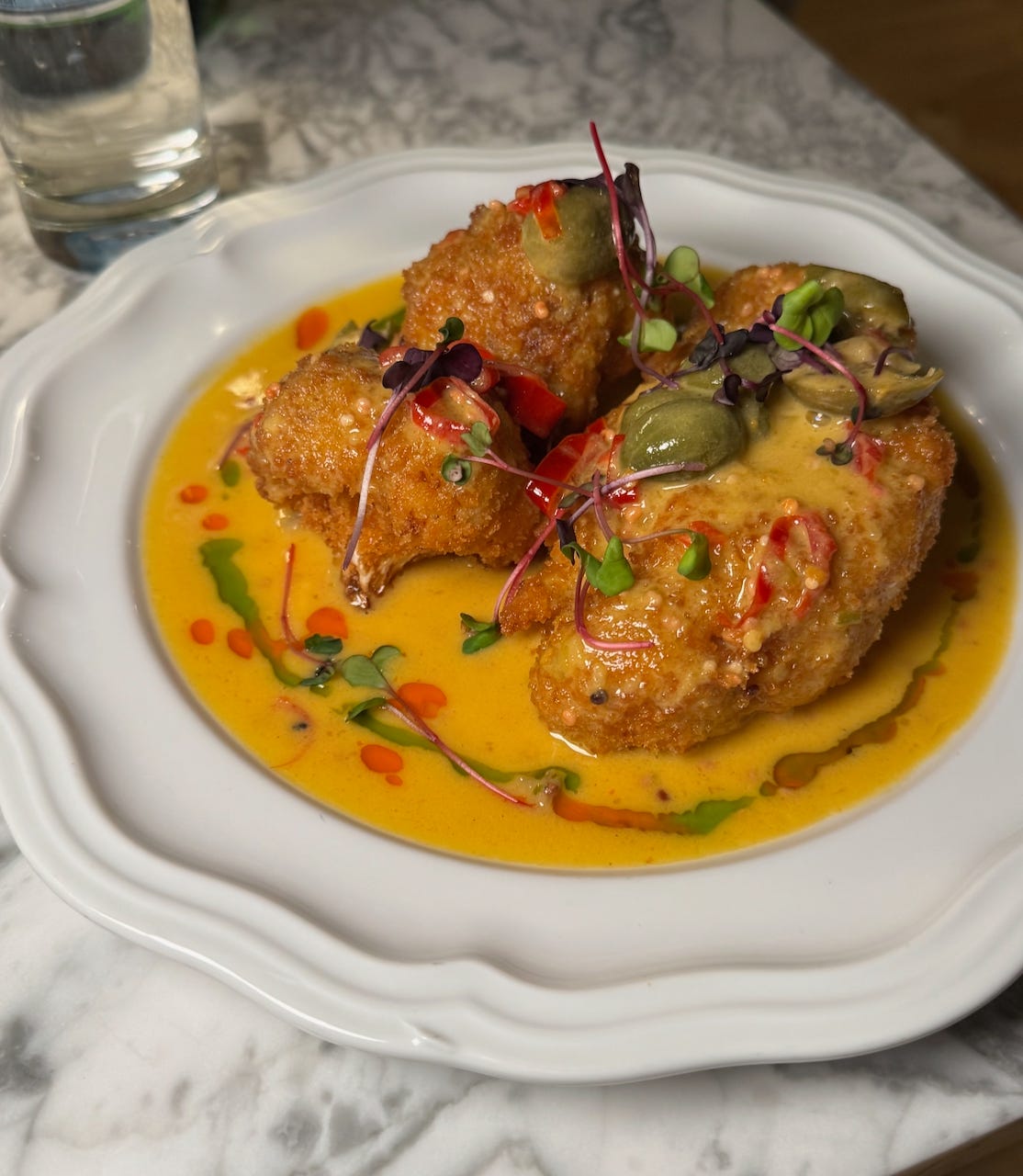
The item eats like a vegetarian steak in a way, thick and substantial. I’m not talking like a vegan lion’s mane mushroom steak; more like a fried chicken perhaps given the breading. That makes me think of chicken piccata as I write it, which makes sense with the sauce. So, now you see why it’s listed as a larger plate.
Lastly for our savory tasting, we’re presented with a Carnaroli rice risotto flecked with seasonal Olathe corn and shiitake mushrooms grown by Fort Collins’ Hazel Dell Mushrooms. It’s a non-traditional take, starting with a corn stalk and Parmesan-rind stock instead of a chicken stock. They melt sweet corn butter and grated Parmesan into the rice and finish it with mascarpone, giving it a richer body. The corn provides little juicy pops as you eat, and I taste green peas for some reason faintly, even though they’re not actually there amidst the starchiness.
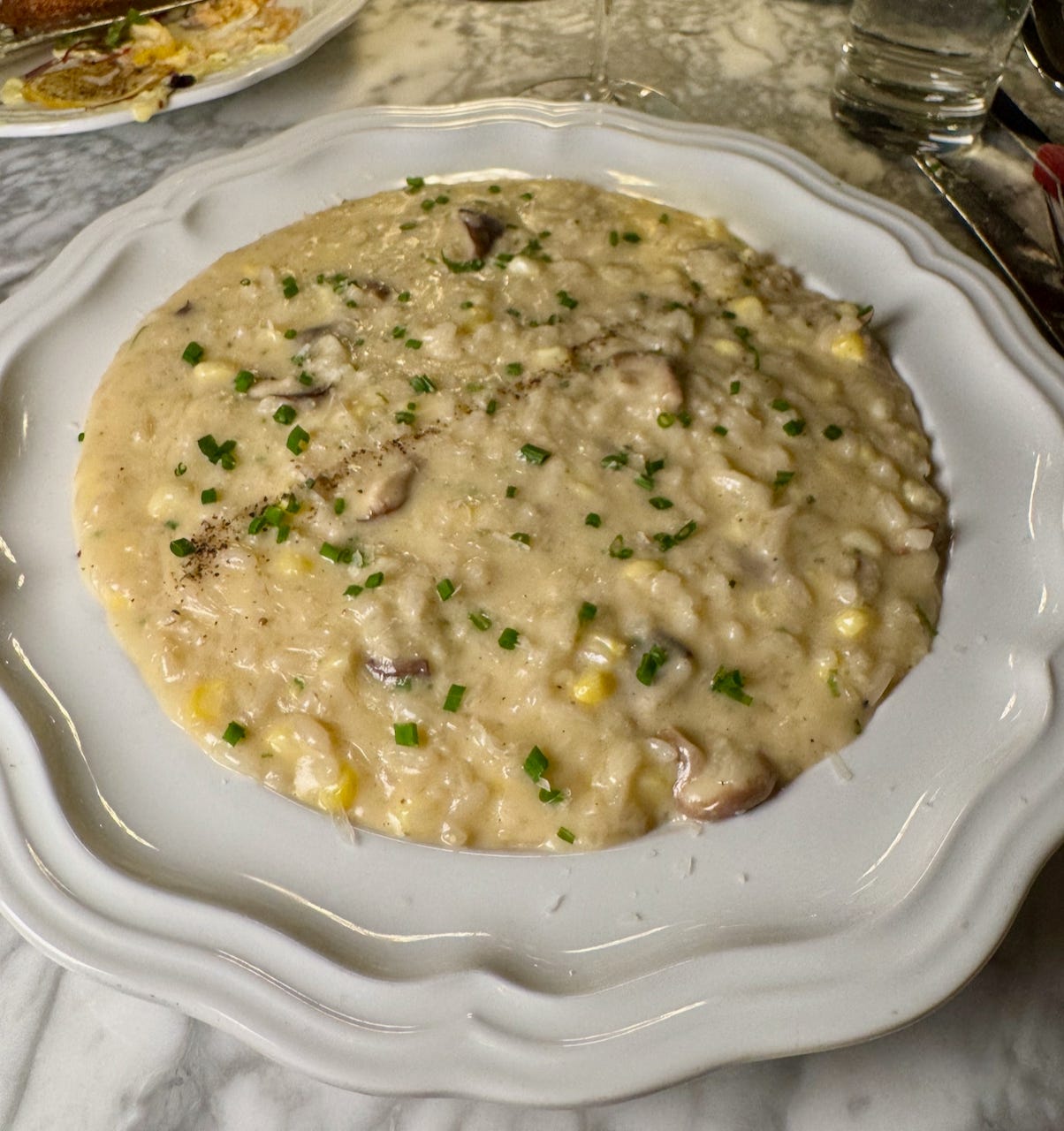
This is the dish that comes alive the most with a wine pairing, and the Arneis white wine works wonderfully. I’m talking with the chef and snapping photos and eating, so I neglect to take proper tasting notes on the wines, all of which are Italian and meticulously selected by Gunderson. What’s clear though is the acidity greatly complements the risotto creaminess and earthy elements.
With the bolognese, we drink a Nebbiolo (from it’s birthplace, in Piedmont) to try to stand up to the meatiness with high tannins and acidity. It does the job well, even though my eye reads it in the glass as more delicate: it’s like light, almost opaque like a Pinot Noir, with purplish-brown edges and fast legs that speak to the higher alcohol percent. It’s an excellent $18 glass to top the red selection.
Our meal concludes with a shared cappuccino (from Hold Fast beans) and Italian pistachio gelato sourced through Denver’s Italco. It’s pleasantly not green from food coloring like too many synthetic pistachio ice creams, and isn’t over-sweet either. Chunks of decorative pizzelle Italian waffle cookies are suspended from the silver service cup like angel wings, making me think of some Italian Renaissance flourish.
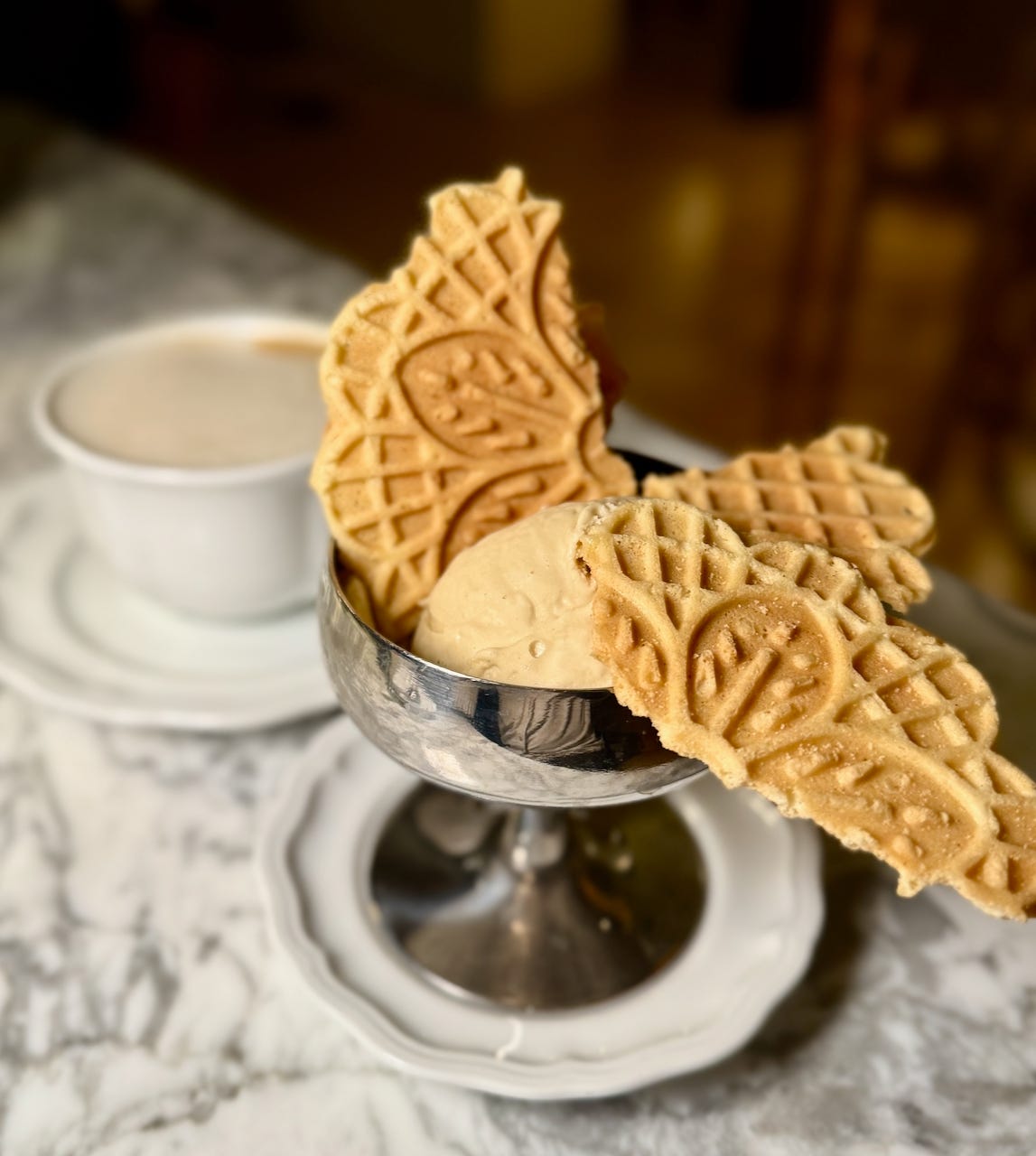
Whether that’s intentional or not I didn’t ask. The Western, Italian, gold-saturated themes are so well explained and exemplified design-wise that it’s nice to find a kernel of something unexplained for me to quietly experience. I like the concluding mystery of not knowing. A sweet finish that needs no expository drama. It’s like silently enjoying a sunset, in Italy or Colorado, sans spoiling the beauty with words.